One Piece is a manga I've caught up to pretty recently, in the past year, but it had me hooked almost immediately and I knew it was going to be my favorite. The author, Eiichiro Oda, really is a genius for story-crafting and style.
Story
Short Synopsis
The manga is about Monkey D. Luffy, a boy who follows his dream to become the King of the Pirates. A few decades before the time show introduces us to, there has been a great pirate, Gol D. Roger. He was considered the King of the Pirates, and entirety of the Marine organization, trying to fight crime at the sea, was after him. When he was finally caught, he was publicly executed. But at the gallows he smiled and said that he left all of his treasure "there," and that it belongs to anyone who finds it. That quote started the great Age of Pirates, where many set out to the sea in search for this epic treasure - One Piece
.
Themes of the Manga
While this piece explores the usual shounen themes - friendship, adventure, determination - I'd like to take a few blind guesses as to what else might be the aim of the work. But let's explore how the standard themes fit into One Piece first.
Friendship
Friendship in One Piece is presented as one most important thing you should value. Luffy, the main character and the captain of Strawhat crew, cherishes his crewmates and friends in general more than anything else. He calls his crewmates "nakama," which is hardly ever translated into English, because in One Piece it holds a special meaning. Nakama isn't just your friend, nakama is someone you're so close to you're almost like family. It's a friend who shares your life's journey with you. One of the main conflicts is everyone struggling to protect their friends, but yet believing in them and leaving them space to work things out themselves and grow as people. It's speculated that "One Piece" is actually a symbol for Strawhat crew being One Piece and not being able to fall apart, and that they work in perfect harmony (at least by my standards of perfection and harmony) while together.
Adventure
Pursuing adventure for the main characters, especially Luffy, has very little to do with fame, fortune or generally some higher goal. Luffy loves adventure for the sake of adventure. Of course, he wants to become a famous King of the Pirates, and, as he himself eloquently put it, and I paraphrase, "I don't want to be a hero. Hero shares his meat with everyone in the village. I want to eat meat." But in adventure, he seeks to experience new things, to see as much of the world as he can and to expand his freedom to the ends of the seas.
Determination

A common theme in shounen is that determination wields power. The more determined you are to win, the more likely you are to, no matter the odds. One Piece does fall under the category that plays with this theme quite eloquently. Sometimes it lets us be dreamy and shows us the power characters can achieve if they want something hard enough. But often, it doesn't quite let them have it all. We are introduced to this blade of willpower that is able to cut down any enemy, no matter how strong, in order to protect what's dear to the protagonists, but then eventually they bump into a wall. They meet an enemy that they can't beat, and because we've already been introduced to how strongly they wanted to be able to for someone's sake, it really has an impact when they actually fail. But the most important thing we learn (and I'll explore this more when I analyze specific characters) is that they always get up and use that determination to motivate themselves to try even harder, instead of falling into misery and self-pity.
_____________
Now that we've covered the main themes, also the themes that fall under the trope for pretty much every shounen, it's time to focus on some lesser themes that have been heavily explored, that might not be the main themes of the series, but definitely a part of many arcs.
Justice Versus Mercy
This show is very careful and calculated in its approach to its antagonists. We're simply not allowed to hate a character completely. We have to understand every antagonist and their motivation, and while in the beginning they might have been just shallow internal conflicts (Alvida and Axe-hand Morgan), they grow in their complexity and empathibility (yes, I just made up that word) as the series progresses up to some villains that I would easily qualify as the best psychologically motivated and explored antagonists I've read about, and I don't mean only in manga. What's interesting is that Luffy, our standard airhead protagonist, may be the best character in the manga in terms of recognizing and acknowledging other people's motivations. If those motivations are good and if they turned to the bad side for the sake of good (Coby wanting to be a Marine, Gin wanting to help his crew, Nami wanting to help her village, Elbaf warriors fighting for honor, Vivi fighting them as Miss Wednesday, Robin, both as Crocodile's assistant and when she escaped their crew, Garp not saving Ace, Bellamy) people are motivated to help them overcome their issues and turn back to the good in them, but if their motivations strive from greed, being vengeful and similar emotions Luffy doesn't hesitate to send them flying with a punch. And that's an important lesson - We should definitely try to understand the other side and help them out, but we shouldn't be delusional and try to find good where there's none to be found. Now, I'll be the first one to argue that everyone has a little good within themselves, but we must realize that reaching out to that person and really pulling them up requires the amount of effort that, if we don't go to those lengths, makes us all a bit hypocritical for judging others for judging others.

However, it's very interesting that although he's fought countless battles and there's many people Luffy said he would never forgive, he never killed any of his enemies. When they clash, their fight is a clash of ideologies as well, and Luffy manages to crash their convictions, pride, and drive them away from their prey. Marines often capture Luffy's enemies, tho, which leads them to death or Impel Down or death in Impel Down.
Also, in a more literal sense, Marineford arc explores the topic of justice heavily. We're all on the side of pirates, but we know that pirates also aren't really the most just people. While there are crews like Strawhats, many are just merciless killers and burglars and we can really see the motivation of the Marines to fight them. On the other hand, we also see that Marines are limiting one's freedom, lying to them, hiding the truth and killing people in order to hide it. We see that both sides have the good and the bad.
As Doflamingo eloquently put it: "Justice will prevail, you say? But of course it will! Whoever wins this war becomes justice!"
Hatred
Definitely one of the main themes of this manga is hatred and how it is past over and how to overcome it. Some of the arcs, like Sky Island and Fishman Island arcs focus on the hatred birthed from lack of knowledge and understanding of the other side, the sociological kind of hatred, that we can also notice in everyday life. Racism, nationalism, sexism, homophobia. All those really strive from the lack of understanding of the other side. We feel nice and cozy in our own skin and with things we are familiar with, things we grew up with, but when we look outside of our little box we find much much more than we've expected there is, and oftentimes we escape. We don't want to face the darkness of the unknown, so we lock ourselves in and rationalize that what's outside of the box must be bad, and then we pass on the anger we feel towards ourselves for not being brave enough to explore it onto others.

The second type of hatred, which is also toyed with during the manga, is personal hatred. It's one of the rare mangas that doesn't use personal hatred as direct motive for revenge, for example. This one can again be divided into two types: hate for others and hate for oneself.
A perfect examples of how hating others develops characters are one of the recent ones: Law and Doflamingo. Both of their hatred's have been born out of love. Law loved his family and village and his hatred towards the world was born out of love for what he had lost. Corason managed to let the boy love again, but was also mercilessly taken from the little boy, birthing hatred towards Doflamingo, fueled by all the hatred he succeeded to overcome thanks to Corason. Doflamingo, on the other hand, started hating his father for the utterly stupid moves he made placing Doflamingo himself and the whole family in an awful situation, at best. This goes to show that hatred is usually born to replace the love for what we had lost, usually in some way due to the person we turn the hate towards (although people also tend to blame others for their own mistakes).
While a dose of hatred to oneself is present in hatred for others (usually the person feels the guilt for being unable to do anything and projects it on others), hatred towards oneself is still more present in the characters who don't channel it onto others. A perfect example of this would be Nico Robin, whose confidence has been crushed by the amount of hatred she was getting. She blamed herself for what happened to her village and her mother, she blamed herself for every crew that fell when she fled, she blamed herself for being unable to protect Strawhats but by sacrifice. She hated herself for what was done to her, instead of placing blame on others. This is also present in Luffy, although he channels it in a positive way. When he thought Sabo died, he became desperate to protect what he loved, so he turned his hatred into a motivation an a noble goal. He's protected his nakama ever since, but after Ace's death we see that feeling awaken in him when he says that "he's still not able to protect anyone."

D.
Whatever D. is, we know it's going to be one of the main themes of the whole series. For now, we know D. would be the natural balance to the Celestial Dragons, the nobility. I guess that means they're some sort of rebels, or progressive people that allow the world to move forward. The force of chaos. If it was up to Celestial Dragons, the world would stay in the age where they lead and nobody is allowed more power, but D.s will continue to push forward. I can't help but think this has a lot to do with the lost century and Joy Boy and everything Robin is researching, but it remains to be seen.
Drawing Style
Oda, obviously, has his own very unique style. Many even refuse to watch the anime or read the manga because they find this drawing style aesthetically unpleasant. I won't go into how big of a mistake they're making now, because I want to focus on pros and cons of this simplistic drawing style and why it fits Oda so well.
While many argue that characters are, plainly put, ugly, I find them much more life-like because they're really very unique look-wise. Although women (at least women Oda wants to portray as beautiful) are drawn very similarly and some would be difficult to tell apart if it wasn't for hairstyles, Oda admits to not being able to draw women very well. He thus resorts to this template-based characters. On the other hand, variety in the male part of the cast is humongous. Everyone's looks fit their personality quite well, or don't fit at all to emphasize the irony. Whichever the case, this is used pretty cleverly.
If you read the manga very quickly, like I did, you'll find it very easy to notice the gradual improvement in Oda's style over the years. Although basics stayed the same, his characters now seem way more dynamic. However, he was a master at expressions ever since the start of the manga.
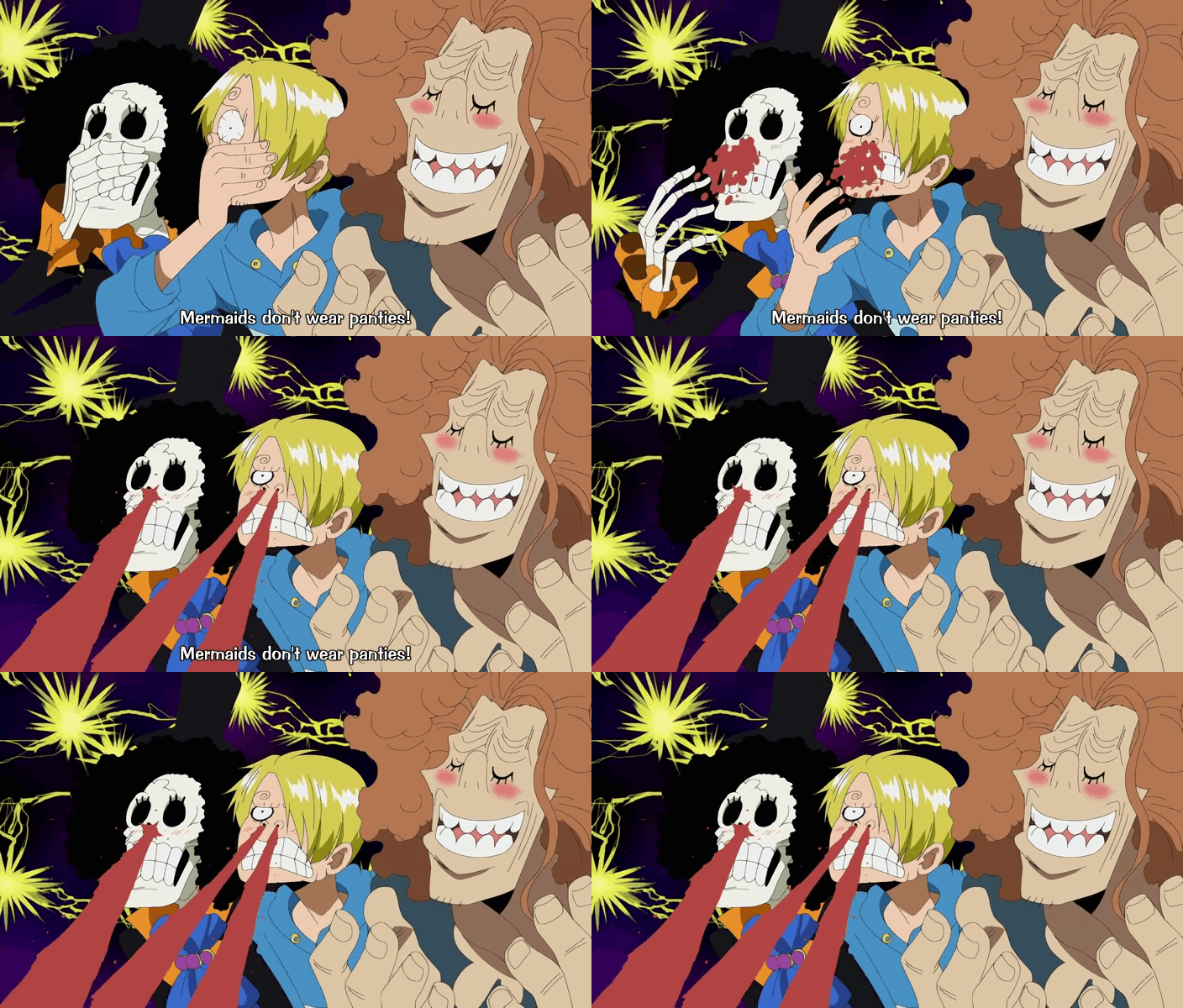
I suppose that it really falls back to personal taste, although I think this is the kind of art you just need to get used to. But whether we like it or not, I think we all agree that enthusiasm on Sanji's face up there, as well as many other such scenes, both small and big, can't be portrayed the same way in any other style. I mean, Doffy wears sunglasses all the time, yet he's one of the most expressive character's I've seen!
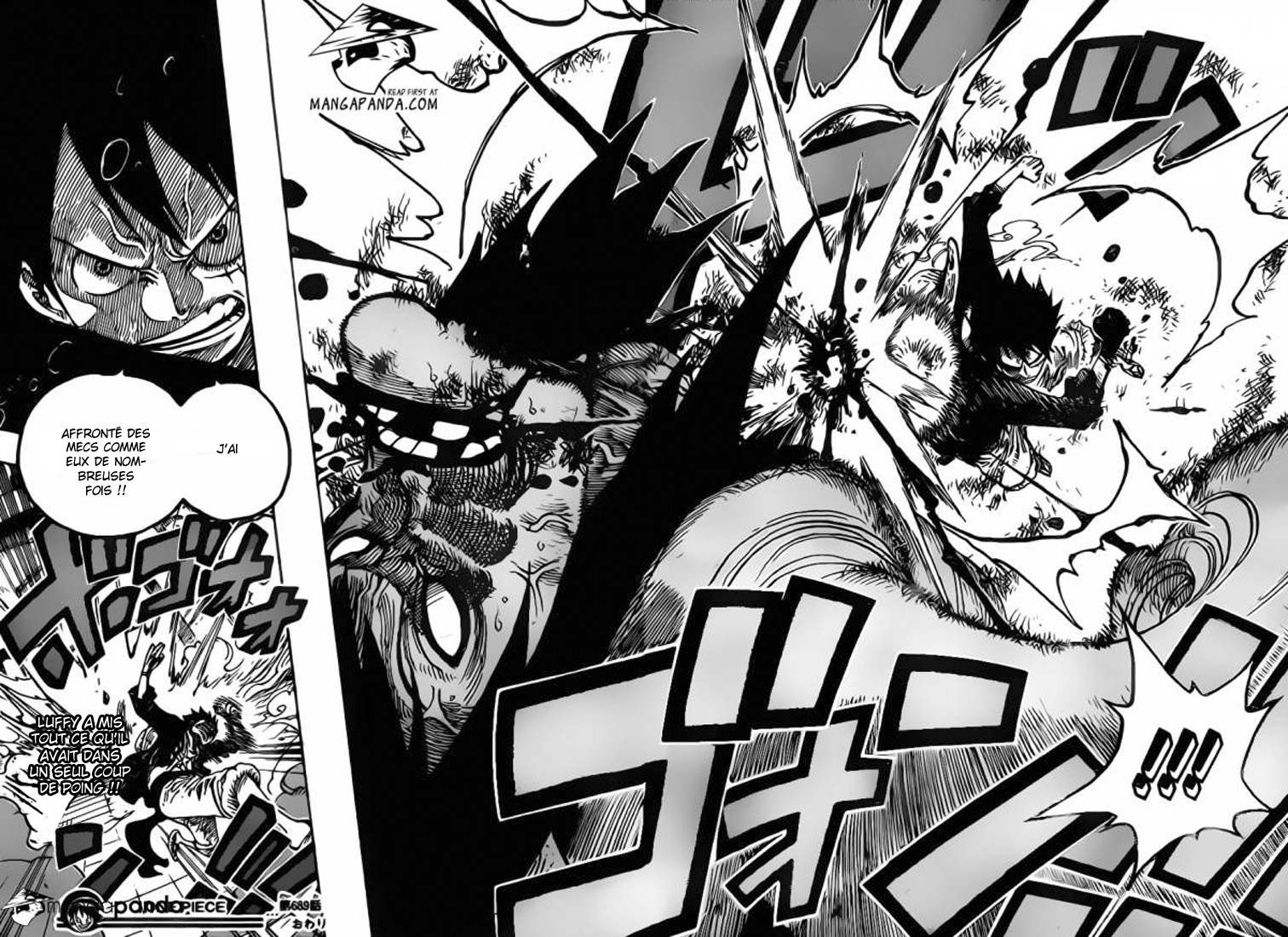
Cadre placing is also very interesting to look at, if you're into storytelling. It really provides dynamics that can, I would argue, replace the motion pictures of the anime (nothing can compare to the seiyuus, tho). For example, on one page we have normal little cadres of Luffy preparing to deliver a punch, and then on the next we have a huge two-page illustration of the moment of impact.
Characters
In the last bit I want to focus on One Piece's strongest point, and those are most definitely the characters. I'll point out some general things about character development in One Piece that I like and dislike. I wanted to go through character development of all the Strawhats and some other major characters, but this article is already pretty long, so I'll leave that for another day.
Flashbacks
While Oda is famous for being able to make you bawl in a three-page flashback and complain how he doesn't allow for any major character to stay shallow and unexplained, and while I still find every flashback done by Oda amazing no matter how much I doubt his ability before I read them (just so he could prove me wrong every time), there are a couple of things I don't like about flashbacks.
First of all, we got attached to nearly all the Strawhats through them. Which is an interesting phenomena that I'm planning to attempt to explain. You see, in every flashback you have a character who helps the protagonist, usually by sacrificing something big for their sake or being sacrificed to teach them a lesson (Luffy - Shanks, Zoro - Kuina, Nami - her mother, Chopper - Dr. Hiluluk, Robin - her mother and Jaguar D. Saul, Franky - Tom). We tend to empathize with those people sacrificing something great for them and while we're at it we pick up the care they hold for the protagonists. Basically, we feel what the character being sacrificed feels for them. This is present in many other flashbacks throughout the journey, most recently Rebecca's and Law's.
However, characters, especially Strawhats, are very heavily developed real-time and they aren't just left as empty shells with their flashback to fill out the character development, thus excusing this habit Oda has. But it's very funny when you consider the fact that Brook is generally the most unpopular Strawhat, and he's basically the only one who didn't get that kind of flashback. He was the one sacrificing for Laboon and dying among his crew. Usopp, also, didn't have his flashback be of the above sort, but he's got people attempting to sacrifice for him real-time.
Number of Strawhats
Currently, we have 9 main characters. Luffy, of course, it the main character, but other Strawhats are almost equally as important. The problem with this is that, when we have nine characters to follow through a relatively elaborate arc, it's likely some won't get enough screen time or won't be there at all (as it is, we haven't seen the part of the crew that stayed on Sunny for a year). While this is not really a major issue, as more Strawhats keep joining we see arcs running longer and longer in order for every of them to have their epic battle and show their contribution.
Dialogue, interaction and jokes
The dynamics of the crew is pretty strong and they fit in really well. Their interaction in between action is mostly made out of gags that we all know by know - Zoro and Sanji fighting, Usopp having unable-to-step-on-a-new-island disease, Nami yelling at everybody to use their brains, Luffy caring only about meat and getting them into as much danger as he possibly can, Brook cracking skeleton jokes and so on. To some, myself included, these jokes never get old.
______________________________________________________
All in all, this manga is amazing and I'd really recommend to anyone looking for something to watch. And don't let the number of episodes scare you, the quality is not only not dropping, but rising as the story progresses!
 I'm entering this awesome giveaway by Toxic Tears and she's giving away Kawaii Boxes, which are surprise boxes with cute, Japanese things.